

In the realm of modern business operations, IT services are the backbone. What’s important to know is that all these crucial services operate on underlying hardware and operating systems, or in some cases, hypervisors. The smooth running of a business can face serious hurdles in case of hardware or OS failures. And the impact will not just be operational; it will extend to potential income and reputation losses as well.
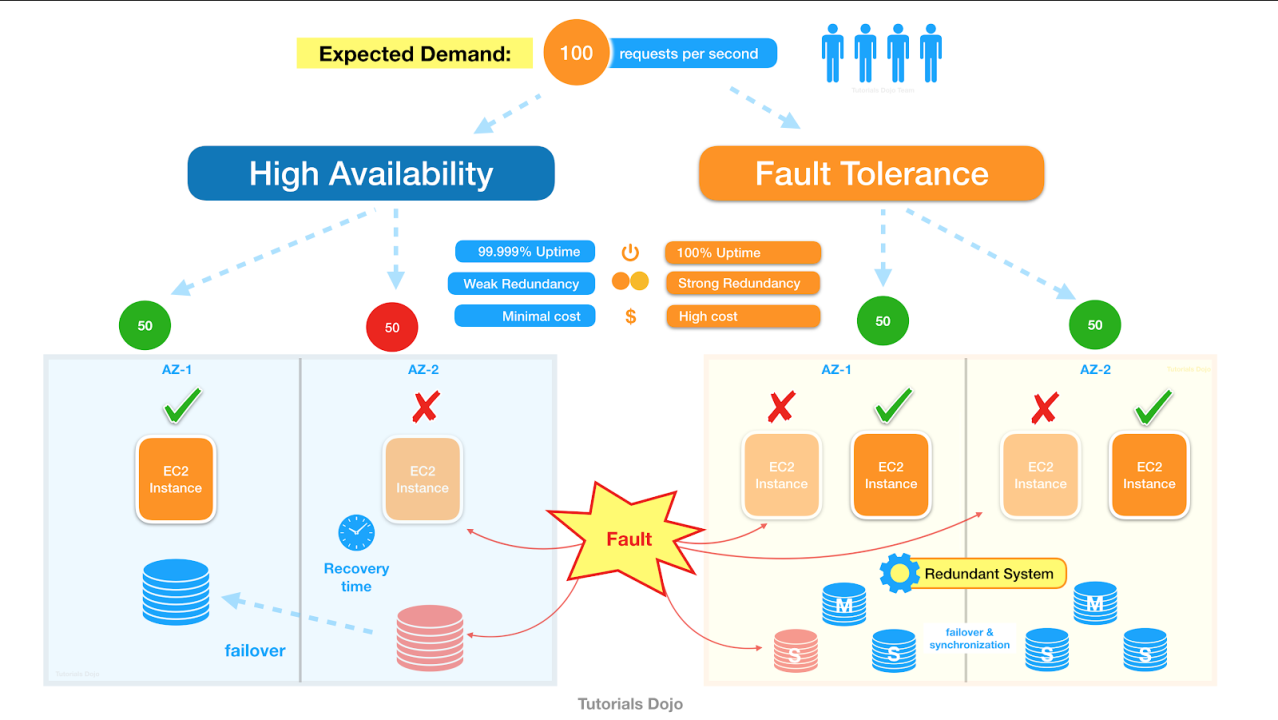
To safeguard against the risks associated with IT infrastructure downtime, there are two main strategies: High Availability (HA) and Fault Tolerance (FT). However, despite their critical roles in ensuring operational continuity, there’s often confusion about what High Availability (HA) and Fault Tolerance (FT) truly means.
Read on to explore the nuances of High Availability (HA) and Fault Tolerance (FT). We will delve into the ‘high availability vs fault tolerance‘ debate, to understand what these concepts entail and determine which is most suitable for your business needs.
Short on Time? Here’s a Quick Comparison Between the Two
| Criteria | High Availability | Fault Tolerance |
| Implementation Costs | Moderate | High |
| Implementation Level | Application and Infrastructure | Application and Infrastructure |
| RPO (data loss) | Zero (data in RAM may be lost) | Zero |
| RTO (downtime) | Up to a couple of minutes | Zero |
| Ransomware Protection | No | No |
| Performance Impact | No | Possible impact due to RAM & CPU-state replication |
| Complexity of Deployment and Management | Moderate | High |
| Hardware Footprint | Reserved hardware for failover, shared storage | Reserved hardware for real-time replication |
| Purpose of Usage | Minimizing system downtime, automatic failover | Running applications/services without interruption |
High Availability: Ensuring Operational Continuity
Definition and Key Features
High Availability refers to a system’s capability to remain operational over a significant period. These systems remain in operation even in the event of a component failure. The essence of High Availability is not the elimination of failures but the quick recovery from them.
Key features of High Availability (HA):
- Moderate Implementation Costs: HA solutions are generally less expensive compared to FT solutions.
- Zero RPO with Potential Data Loss in RAM: HA systems aim for no data loss. Although in some scenarios, data in RAM may be lost.
- RTO of Up to a Couple of Minutes: HA systems recover quickly, typically within minutes.
- No Direct Ransomware Protection: Like Fault Tolerance, HA doesn’t inherently protect against ransomware.
- Minimal Performance Impact: HA systems usually operate without significantly impacting performance.
- Moderate Complexity: Deployment and management of HA systems are relatively straightforward.
- Hardware Requirements: They require reserved hardware resources for failover and shared components such as storage
High Availability Benefits and Drawbacks:
| High Availability Pros | High Availability Cons |
| Cost-efficient compared to Fault Tolerance | Brief interruptions during component failure |
| Widely available, including open-source | Potential data loss in RAM |
| Easily scalable using cluster concepts | Lacks ransomware protection; needs extra measures |
| Better RPO and RTO than backups | Requires more hardware resources |
| Automated service recovery |
Real-World Application
In practical terms, HA is suitable for scenarios where short downtimes are manageable. For example, in an online retail platform, a brief interruption might not significantly affect customer experience or business operations.
Fault Tolerance: Zero Downtime, Zero Data Loss
Definition and Key Features
Fault Tolerance takes reliability a step further. FT systems are designed to ensure continuous operation without any service interruption, even during a component failure.
Key Features of Fault Tolerance:
- High Implementation Costs: FT solutions demand a higher financial investment due to their complexity.
- Zero RPO and RTO: There’s no data loss and no downtime in FT systems.
- No Ransomware Protection: Like HA, FT doesn’t offer protection against ransomware attacks.
- Potential Performance Impact: Due to the mechanisms like RAM and CPU-state replication, there can be performance impacts.
- High Complexity: FT systems are complex to deploy and manage.
- Hardware Requirements: These systems need hardware resources for real-time replication.
Fault Tolerance Benefits and Drawbacks:
| Fault Tolerance Pros | Fault Tolerance Cons |
| Zero downtime and RTO; unnoticed interruptions | Higher implementation costs |
| Zero data loss and RPO; all data remains available | No direct ransomware protection; needs additional measures |
| Lower performance due to real-time mirroring | |
| Limited true FT products for general virtualized infrastructure |
Real-World Application
FT is essential in operations where even the slightest downtime can result in significant consequences. For instance, in healthcare systems managing critical patient data, or financial trading platforms, any downtime is unacceptable.
Choosing the Right Strategy for Your Business
It’s essential to consider several key factors when deciding between High Availability (HA) and Fault Tolerance (FT) for your business:
-
Assessing Business Needs and Risk Tolerance
- Nature of Business Operations: Evaluate how critical continuous operation is to your services. For example, financial services or healthcare systems, where even a momentary lapse can have severe consequences, may necessitate FT.
- Risk Assessment: Understand the potential risks and impact of downtime. Businesses where short interruptions have minimal impact might find HA more appropriate.
-
Financial Considerations
- Budget Allocation: HA solutions are generally more budget-friendly and offer a good balance between cost and operational continuity. FT, while offering superior protection against downtime, comes with a higher price tag.
- Long-term Cost-Benefit Analysis: Consider the potential long-term financial implications of downtime. Sometimes, the higher initial investment in FT could be justified by the cost of potential downtime.
-
Operational Flexibility and Scalability
- Scalability Needs: HA solutions often provide more flexibility in scaling operations up or down. FT systems, due to their complexity, might be less adaptable to rapid changes.
- Maintenance and Management: HA systems are typically easier to manage and maintain, which is crucial for businesses with limited IT resources.
-
Complementing Strategies with Additional Measures
- Backup and Disaster Recovery: Regardless of choosing HA or FT, it’s vital to have robust backup and disaster recovery plans in place. These measures provide an additional safety net against data loss and system failures.
- Regular Review and Updates: IT infrastructure requirements can evolve. Regularly reviewing and updating your HA or FT strategies ensures they align with your current business needs.
Conclusion
Understanding the differences between High Availability and Fault Tolerance is crucial for any business that is relying on IT infrastructure. As it is clear now, HA focuses on rapid recovery from failures. And FT is about ensuring continuous operation with no downtime.
The decision to implement either should be based on a thorough analysis of business requirements, budget constraints, and the potential impact of downtimes — as indicated above
