


AI specialists are changing modern SEO at a deep level. This is a big shift, moving SEO past simple keywords into intent analysis, personalized experiences, and early trend spotting. The question is not if AI is changing SEO, but how far it reaches across content, technical work, and strategy, calling for SEO pros who can use these tools well.
Online activity shows why this change matters. Every minute, Google handles about 5.9 million searches-354 million each hour, 8.5 billion each day, and about 3 trillion each year. Trying to manage this sea of data and intent without AI is like steering without a compass. AI now drives keyword research, content work, and prediction, giving insights that used to be out of reach.
This is here now: 86% of SEO pros use AI, and 65% say it gives them better results. To learn more about the people leading this change, see the TOP international specialists shaping this fast-changing field.
How AI Specialists Are Changing SEO Strategies
The role of AI specialists has grown from pure analysis to planning search visibility end to end. They use AI to read large data sets, spot patterns, and build focused campaigns that match user intent. Their strength is knowing both how algorithms work and how to apply AI across the full user journey so companies stay competitive in an AI-led search market.
AI is not replacing SEO pros; it is lifting their role. People spend more time on strategy and creative problem-solving while AI takes on repetitive, data-heavy work. This mix of human judgment and machine speed drives modern SEO wins.
What Are the Key Roles of AI Specialists in SEO?
AI specialists handle several core jobs that matter in today’s search landscape:
- Turn raw data into clear insights for action
- Build and use AI tools for advanced keyword and entity research
- Shape content plans using data on intent, gaps, and performance
- Run AI-driven site checks to spot speed issues, broken links, and duplicates
- Map user journeys and align content with search needs
They use AI to study top content and guide teams on topics, headings, reading level, and internal links. They also run fast technical audits with AI-powered crawlers to find load-time problems, broken pages, and schema issues, which help both crawlers and users.
How Is the SEO Landscape Shifting Toward AI-Driven Approaches?
AI can process and make sense of information at a speed and scale people cannot match. Search engines use AI too-Google’s RankBrain (2015) and BERT (2018) improved how search reads intent and context. So ranking for keywords alone is no longer enough; content must answer the real question behind the query.
AI search tools like Google’s Gemini and ChatGPT’s Search GPT now give direct answers and summaries, sometimes skipping website clicks. Brands need to optimize for semantic search, matching the intent behind queries.
The focus is on content quality, E-E-A-T (Experience, Expertise, Authoritativeness, Trustworthiness), and the overall user experience-areas where AI can help measure and improve results.
AI vs. Traditional SEO: What Has Changed?
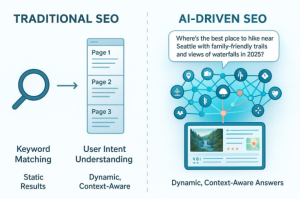
Traditional SEO centered on keywords, links, and basic on-page edits, often done by hand and based on past data. AI-driven SEO is proactive, predictive, and highly analytical. AI tools sort through huge data sets to build intent-focused keyword groups, guide structure, improve readability, and add semantic depth.
Site audits move from slow checks to automated diagnostics. AI also enables personalized results and content delivery, matching each user’s goals-something older methods rarely handled.
| Area | Traditional SEO | AI-Driven SEO |
| Approach | Manual, reactive | Data-led, predictive |
| Data handling | Small samples | Billions of signals |
| Keyword strategy | Exact match terms | Intent and semantic clusters |
| Content | Basic on-page edits | Guided structure, readability, entities |
| Technical audits | Manual checks | Automated, real-time alerts |
| Personalization | Limited | High, based on behavior and context |
AI Technologies Powering Modern SEO
Today’s SEO runs on a set of powerful AI technologies that help teams read language, spot patterns, and deliver useful information with high accuracy. These tools help both search engines and marketers understand what people really want and how to serve it well.
These technologies keep improving, making search more intuitive and responsive. Knowing the core pieces helps explain how AI drives SEO progress.
Natural Language Processing and Semantic Search Advances
Natural Language Processing (NLP) helps machines understand and generate human language. It powers semantic search, which looks beyond exact words to context and intent. AI also leans on structured data and knowledge graphs to link queries with the right answers.
For example, a search for “best waterproof running shoes for trails” points to a runner who needs traction and wet-condition support. Results that address these needs rise to the top. Writers now need to cover the intent behind questions and guide users with clear, helpful content.
Predictive Analytics for Trend Forecasting
AI-driven prediction is a big help for SEO planning. By studying search data, social signals, and site analytics, machine learning spots patterns people might miss. This helps teams prepare for market shifts, seasons, and likely updates, and adjust strategy early.
Tools like Google Trends and SEMrush use NLP and machine learning to flag new topics and queries. This helps teams keep improving as habits and algorithms change, and can reveal fresh long-tail keywords and topics early-giving a real head start in content creation.
Machine Learning in Search Ranking Algorithms
Machine learning drives ranking systems. Google’s RankBrain and Gemini LLM push search toward intent and context. These models weigh many signals-intent, content depth, and E-E-A-T-alongside classic factors to pick the best results for each query.
As ML grows, ranking becomes even more context-aware. SEO plans need to adjust often and aim to satisfy the user’s need, not just hit a keyword list.
Google Search Generative Experience (SGE) and Its Impact
Google’s SGE blends classic results with AI answers, giving quick, useful summaries inside the results page. About 58% of informational queries already trigger AI overviews, which can give people what they need without extra clicks.
This changes SEO. It puts more weight on content that is thorough, credible, and easy for AI to parse and summarize. Brands should aim to appear in these overviews by offering clear, factual answers, showing strong E-E-A-T, and structuring pages so AI can read them easily.
Essential AI-Powered SEO Tools and Services
AI’s value shows up in the tools teams use every day. These platforms cut busywork, reveal deeper insights, and help teams build better plans faster. For any company that wants to stay competitive, adding these tools is a must.
From faster keyword research to automated tech audits, these tools let people focus on strategy while AI handles data-heavy tasks. It’s a practical mix of human skill and machine support.
AI Tools for Keyword Research and Topic Clustering
AI tools like SEMrush’s AI Keyword Tools, Ahrefs, and SurferSEO scan huge data sets to find intent-focused keyword clusters, long-tail terms, and voice-ready queries in minutes. They go beyond volume to show relationships between terms and entities.
They also help with topic clusters-mapping pillar pages and related content so a site becomes a trusted hub. By spotting semantic links and co-occurring concepts, these tools support a stronger content plan that fits how search engines read topics, not just single keywords.
Intelligent Content Creation and Optimization Platforms
Platforms such as Frase, Surfer SEO, Jasper, and Grammarly help teams create useful content that fits user needs. They review top pages and suggest headings, internal links, natural keyword use, and reading ease for both people and algorithms.
Generative tools like ChatGPT speed up drafts, improve keyword coverage, and support multilingual output at scale. Human review still matters for correctness, originality, and brand voice. Used well, these tools help teams publish helpful content quickly without turning out generic posts.
Automation in Technical SEO: Site Audits and Beyond
Technical SEO has also leveled up with AI. Smart crawlers and monitors flag issues that hurt performance: broken links, image problems, slow pages (a big part of Core Web Vitals), thin or duplicate content, and schema errors.
Platforms like Ahrefs and Uniform use machine learning to provide clear, practical insights without extra code. This keeps a site technically sound for both bots and users and frees teams to work on higher-impact projects.
Changing SEO Tactics Through AI Expertise
As AI improves, SEO tactics shift from old habits to data-led methods. True AI expertise means weaving AI into each step of the plan, blending automation with human judgment to get better results.
Modern SEO calls for a proactive approach: personalize experiences, prepare for new search formats, and react fast to updates. This section covers how AI is reshaping the playbook.
Content Personalization and User Behavior Insights
AI helps match content to each person’s needs. By reading past actions, purchases, and live behavior, AI can guide responses and delivery for each visitor, turning one-size-fits-all pages into relevant paths.
Behavior tools give live insights into what users prefer. Marketers can target messages by audience and timing. Better personalization boosts engagement and improves user experience, which often leads to more conversions and loyalty.
Voice and Conversational Search Optimization
Smart assistants like Alexa and Google Home have changed how people search. Voice queries are longer, natural, and specific. AI now understands these patterns far better than before.
Voice optimization needs more conversational phrases and long-tail terms. AI can review content for natural language use and suggest voice-friendly wording. Also use structured data so answers are clear and easy to pull into voice results.
Real-Time Data Analysis and Reporting
AI gives live analysis across views, engagement, and conversions. Teams no longer have to wait for weekly reports. They can shift budget and effort quickly to what works.
Custom dashboards join data from Search Console, Analytics, and rank trackers into a wide, up-to-date view. AI also tracks rivals in real time to spot gaps and new chances fast. This speed helps teams act early and keep performance moving in the right direction.
Adapting to Algorithm Changes with AI
Search systems change often, and updates can move rankings a lot. Fast response matters, and AI is a strong partner here. AI agents can read shifts in behavior and guide quick changes in tactics.
Because AI can analyze large data sets quickly and learn from user actions, it helps teams adjust before issues grow. The same playbook used in fields like finance and healthcare applies: use AI to scan big data, then move quickly with targeted updates.
Balancing AI Insights with Human Creativity
AI brings speed and pattern-finding, but people bring strategy, empathy, and story. Problems arise when teams lean too much on AI to replace real expertise.
Skilled SEO pros set direction, interpret results, and write with a brand voice that connects. The best outcomes happen when AI speeds research and production, and people refine, guide, and add unique value and clarity.
What Are the Benefits and Risks of AI-Driven SEO?
AI in SEO brings big upsides and real risks. You get speed, scale, and sharper decisions-but you also face questions about data use, over-automation, and how search engines treat AI-made content.
Getting this right means using AI with care, knowing its limits, and watching for ethical and privacy issues. Below are the main points leaders should weigh.
Advantages: Efficiency, Scalability, and Accuracy
- Efficiency: AI cuts manual work like keyword research, meta edits, and audits, so teams can focus on strategy. About 75% of marketers use AI to automate repeat tasks, saving a lot of time.
- Scalability: AI lets brands handle large data sets, many markets, and complex campaigns faster than human teams alone. This supports quick shifts when markets or algorithms change.
- Accuracy: AI sifts billions of signals to find precise keyword gaps, predict trends, and spot technical issues with fewer mistakes-often lifting rankings and growth.
Potential Risks: Data Privacy and Over-Reliance on Automation
Data privacy is a major concern. Many AI tools need user data. Companies must collect, store, and use it responsibly, stay compliant with regulations, and choose vendors with strong privacy practices.
Over-reliance on automation is another risk. Blindly accepting AI output can lead to weak or off-brand content. Human review adds creativity, nuance, ethics, and voice. Too much automation can also make many sites sound the same.
Does Google Penalize AI-Generated Content?
Google does not penalize content just because AI helped create it. It lowers the rank of low-quality content, no matter how it was made. Google wants the best answers for users and rewards helpful, high-quality work.
If AI produces generic or unhelpful text aimed only at ranking, it can hurt performance. But AI-assisted content that is accurate, well-sourced, shows E-E-A-T, and helps the reader can do well. Use AI as a helper to produce better content-not as a shortcut to skip quality.
Future Trends: Will AI Specialists Shape the Next Era of SEO?
SEO’s path is tied to AI progress. AI specialists will guide how search works next, mixing new tech with smart planning to change how people find and use information. The goal moves from simple adaptation to making AI a core part of digital growth.
The basics of connecting people with information stay the same, but the methods keep changing. Teams need fresh skills, and companies should plan for steady AI upgrades across their strategies.
Will SEO Be Replaced by AI?
No. AI will not replace SEO; it will change how it is done. AI can handle research, analysis, and first drafts, but it cannot replace strategic thinking, creativity, or empathy. Skilled SEO specialists are still needed.
SEO’s core-helpful, relevant content that people can find-remains. AI is changing how answers appear through features like AI Overviews. Winning now means knowing user intent and meeting it precisely. AI is a strong assistant, but people guide the plan.
What Skills Will SEO Professionals Need in an AI World?
- Data analysis: Read AI outputs, find patterns, and turn insights into action, including prediction
- User intent and psychology: Add empathy and nuance; write with E-E-A-T and strong storytelling
- Prompting and tool use: Work with AI tools to get outputs that fit goals and brand voice
- Adaptability: Keep learning new tech and reacting to search updates quickly
Preparing SEO Strategies for Ongoing AI Innovation
- Add AI tools to current workflows. Pick platforms that fit your size, industry, and goals (for example, SEMrush or Ahrefs for broad features, plus niche tools for e-commerce or local search).
- Make content quality and E-E-A-T the top priority. Invest in useful, trustworthy writing that earns trust.
- Build a culture of learning and testing. Grow skills in analysis, AI interaction, and strategic planning.
- Stay up to date with tools like ChatGPT and Google’s SGE, and look for smart ways to plug them into your stack so your approach stays effective in a fast-changing market.
