



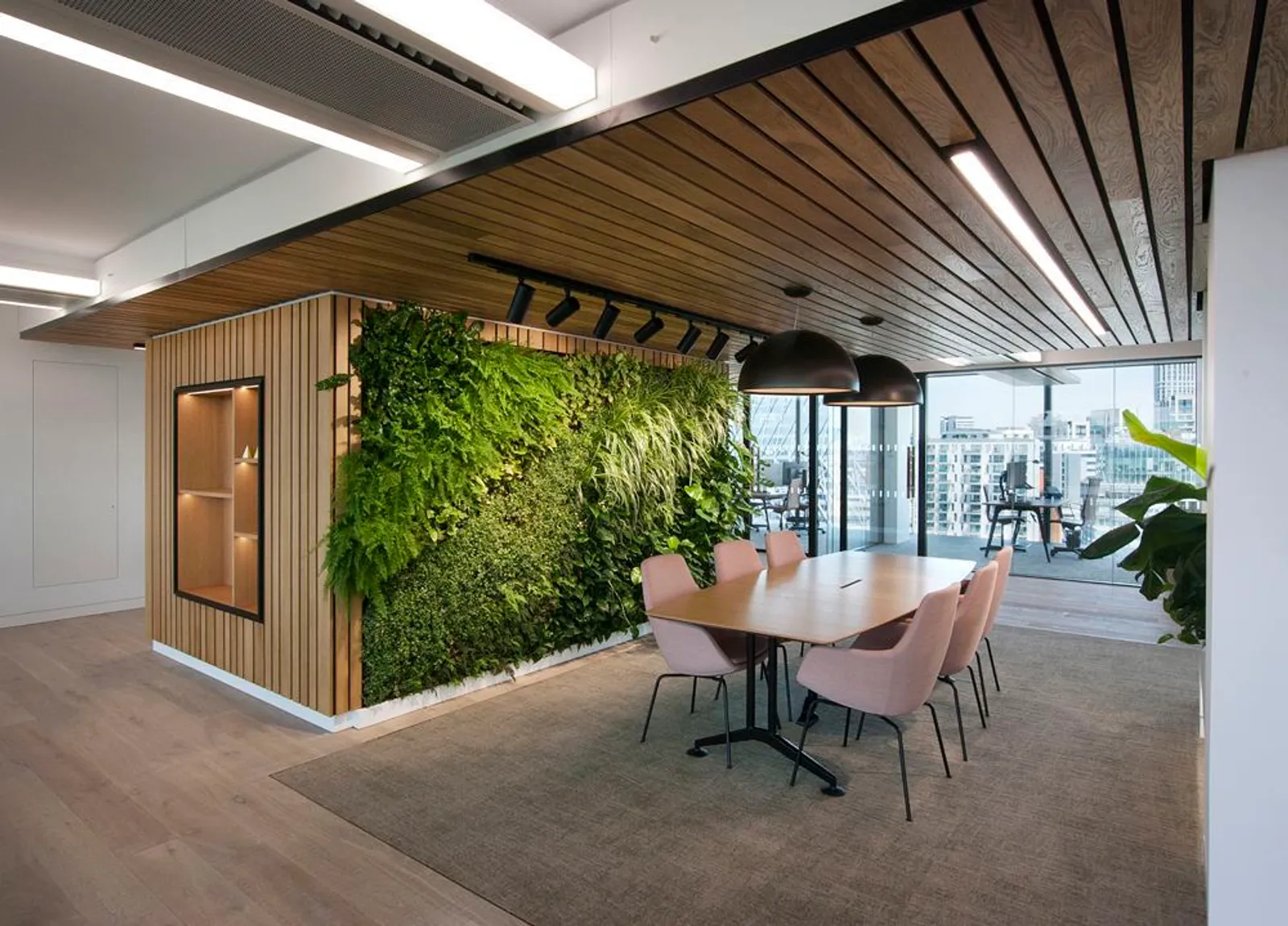
The sterile cubicle farms of the 1990s are disappearing. Today’s cutting-edge offices feel more like living ecosystems—flooded with natural light, featuring living walls, and showcasing warm wood surfaces replacing cold drywall and metal.
This transformation isn’t a passing trend. It’s driven by decades of research into how our surroundings affect performance, health, and wellbeing. The principle behind it: biophilic design.
What Is Biophilic Design?
“Biophilia” literally means “love of life,” popularized by biologist Edward O. Wilson in the 1980s. He proposed that humans possess an innate tendency to seek connections with nature. Biophilic design applies this to built environments, deliberately incorporating natural elements into spaces where people spend their time.
For offices, this goes far beyond a few potted plants. True biophilic design creates environments connecting occupants with nature through direct experiences (natural light, views), indirect experiences (natural materials, patterns), and spatial configurations mimicking outdoor environments.
The Business Case for Nature-Inspired Workspaces
Research supporting biophilic design is remarkably robust. The Interface Human Spaces study found employees in environments with natural elements reported a 15% increase in wellbeing, 6% increase in productivity, and 15% boost in creativity.
The World Green Building Council found improved indoor environmental quality increases productivity by 8-11%. For a company with 100 employees earning $50,000 annually, that translates to approximately $400,000 in additional value yearly.
Beyond productivity, biophilic design addresses workplace mental health challenges. The American Psychological Association reports workplace stress costs U.S. businesses $300 billion annually. Creating stress-reducing environments through natural elements offers tangible solutions.
Wood: The Foundation of Biophilic Design
Among natural elements designers can incorporate, wood holds a special place. Unlike materials that merely reference nature aesthetically, wood is nature—carrying authentic growth patterns, variations, and imperfections our subconscious minds recognize.
University of British Columbia research found visual exposure to wood surfaces triggered physiological responses similar to actual nature settings: lowered heart rate, reduced blood pressure, increased parasympathetic nervous system activity. People literally feel calmer in spaces with substantial wood elements.
A Japanese study in the Journal of Physiological Anthropology found wood contact produced effects comparable to forest bathing. Just viewing wood grain patterns reduced sympathetic nervous activity and increased comfort feelings.
Perhaps most importantly for commercial spaces, wood’s acoustic properties contribute significantly to occupant comfort. Hard surfaces like concrete, glass, and metal create reverberation increasing ambient noise—one of the most common office complaints, particularly in open-plan layouts.
The Acoustic Crisis in Contemporary Offices
Open-plan offices were meant to foster collaboration. Without proper acoustic treatment, they become cacophonous environments where noise dominates complaints.
Cornell University studies found even low-level office noise caused elevated stress hormones and decreased motivation. Workers in noisy environments made 40% fewer attempts at solving difficult problems compared to quieter spaces.
Wood becomes particularly valuable here. As a porous, organic material, wood absorbs sound rather than reflecting it. Wood’s cellular structure acts as countless tiny sound traps, reducing reverberation and creating clear conversation spaces without overwhelming noise.
When incorporated into ceiling and wall systems, wood provides substantial acoustic benefits while maintaining the aesthetic warmth making biophilic design effective. It’s one of few materials simultaneously addressing acoustic performance and biophilic principles.
Functional Benefits of Wood in Commercial Spaces
Beyond visual warmth, wood offers functional advantages often unrecognized in commercial environments.
Wood is hygroscopic—naturally absorbing and releasing moisture to maintain equilibrium with surrounding air. This passive humidity regulation contributes to more stable, comfortable indoor environments.
Modern wood ceiling and wall systems address fire safety concerns that historically limited commercial wood use. Advanced fire-resistant treatments allow wood products to meet stringent building codes while maintaining aesthetic and acoustic properties.
The sustainability story is equally compelling. When sourced from responsibly managed forests, wood is the most sustainable building material available—storing carbon rather than emitting it, renewable, and biodegradable at end of life.
The Wood Ceiling Revolution
Among wood applications in commercial interiors, ceiling systems have emerged as particularly impactful. Ceilings represent the largest uninterrupted surface in most rooms, yet often receive the least design attention. Treating this canvas with natural wood creates immediate visual impact while delivering substantial acoustic benefits.
Modern wood ceiling systems range from linear planks to three-dimensional geometric configurations. Linear systems create directional emphasis, guiding visual flow. Grid and cube configurations add depth and complexity. Curved systems introduce organic forms softening typical commercial architecture geometry.
Properly engineered wood ceilings achieve noise reduction coefficients (NRC) comparable to traditional acoustic tiles while looking infinitely more appealing. They address the fundamental acoustic challenge—excessive reverberation—while enhancing interior aesthetics.
Installation flexibility is another advantage. Modular wood ceiling systems allow custom patterns, integrate lighting, and accommodate HVAC requirements while maintaining visual coherence. This enables biophilic design principles to work within real-world technical constraints.
Making the Investment: ROI Considerations
Wood ceiling and wall systems typically cost more initially than standard alternatives. The important question isn’t upfront cost, but whether they deliver sufficient value to justify investment.
Enhanced employee productivity generates ongoing value far exceeding initial cost differences. Improved recruitment and retention save substantial sums—recruiting costs easily exceed 50% of annual salary. Reduced absenteeism from better environmental quality produces measurable savings.
Life cycle costs favor quality wood systems. Properly installed wood ceiling and wall systems last decades with minimal maintenance. They don’t sag, stain, or deteriorate like acoustic tiles. When calculated over 20-30 year building life, total cost of ownership often favors wood despite higher upfront expense.
Quality wood systems’ flexibility and adaptability protect against obsolescence. As workplace needs change, wood ceilings and walls can be reconfigured, refinished, or updated more easily than alternatives.
Conclusion: Nature as Infrastructure
The most successful workplace environments will recognize nature not as decoration but as infrastructure—a fundamental component of how spaces support human performance and wellbeing.
Wood plays a central role in this transformation. Its unique combination of aesthetic warmth, acoustic performance, sustainability, and psychological benefits makes it ideal for implementing biophilic design principles in commercial environments.
For organizations evaluating workplace investments, the question shouldn’t be whether they can afford biophilic office design elements like sophisticated wood ceiling and wall systems. The question should be whether they can afford not to implement them, given demonstrated impacts on productivity, recruitment, retention, and employee health.
Wood—authentic, warm, acoustically beneficial, and undeniably natural—stands at the intersection of beauty and function, aesthetics and performance. As biophilic design continues to reshape workplaces, wood’s role will only grow more central to creating environments where people don’t just work but truly thrive.


